
By Graham Dixon
Together with Edward Elgar and Gustav Holst, Frederick Delius is one of the key figures of English music in the early 20th Century.

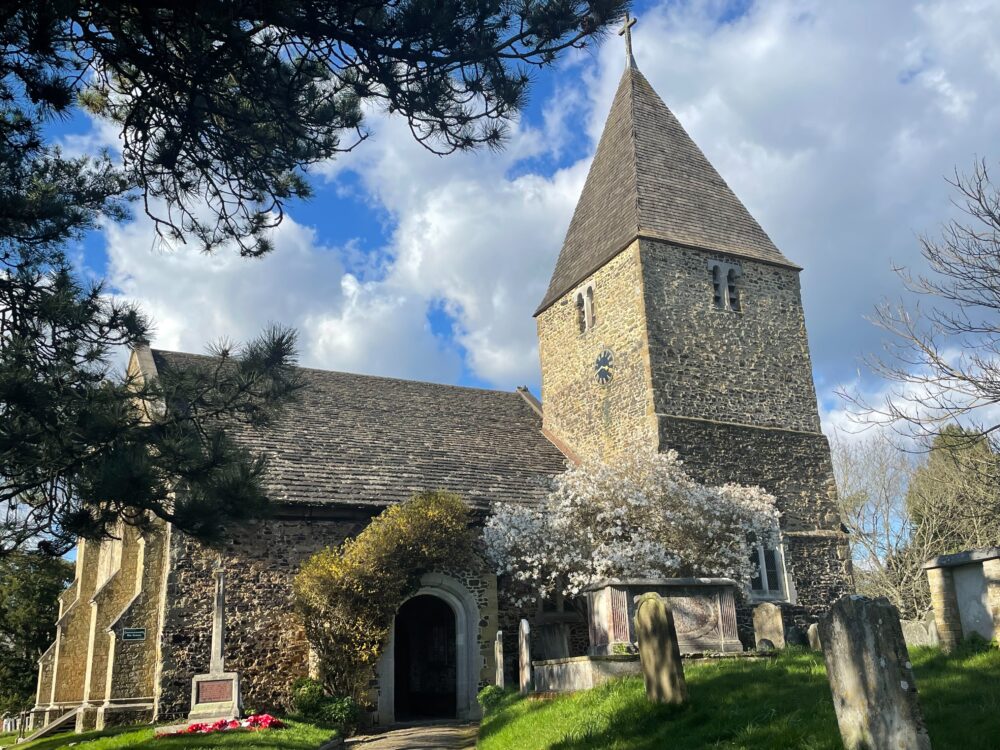
Since he never lived in the area, you might be surprised to come across his grave in Limpsfield churchyard. Delius was born in 1862 in Bradford to German parents, managed a citrus fruit plantation in Florida, and then studied music in Leipzig, Germany. Finally, for the last forty-or-so years of his life, he lived in a village just south of Paris, in a house belonging to his wife Jelka. But what is he doing in Limpsfield? That’s the question I asked when we first moved here.
Both Frederick and Jelka Delius had long harboured the desire to be buried in England. Their closest friends on this side of the channel were the Harrisons, a family of highly talented musicians, who lived just south of the village and attended the parish church.
When Frederick died in 1934, the Harrisons approached the rector of Limpsfield, asking whether the composer could be accommodated in the beautiful churchyard. When the rector gave his agreement, with the consent of the church council, he was probably unaware of the complications that would follow in arranging the ceremony.
The leading conductor of his age, Sir Thomas Beecham, wished to give an oration at the graveside and bring members of the London Philharmonic Orchestra to perform. It was unclear what documentation was necessary to import the composer’s remains from France, where his body has been temporarily interred. And the church already offered an exhausting round of Sunday services in addition to the memorial service which was finally fixed, to suit Beecham’s diary, for 26 May 1935, at 4.00pm.
Some papers, recently unearthed among the archives of Limpsfield Church, provide important background to the preparations for the burial and its aftermath. Among all the details, one myth is effectively dispelled, namely that the burial took place close to midnight because it needed to be shrouded in secrecy. On the contrary, the timing was purely practical.
Having completed the long journey from just south of Paris to Boulogne, the coffin was transported on the evening boat to Folkestone and therefore arrived extremely late in Limpsfield. The burial happened at that hour because the coffin, encased in lead, was too heavy to move in a dignified fashion with a congregation present (a wheeled bier was used to transport it from the lych-gate to the grave) and it also avoided Sunday work on the part of the undertakers. Clearly, with the Sunday services, Delius could not repose in the church overnight.

The newly unearthed papers reveal that, shortly after the church council decision, Jelka Delius visited the churchyard on a rainy November day to inspect the proposed location of her husband’s grave. The tone of the correspondence shows that she was content with the arrangements, dispelling any notion that she might have been coerced by powerful figures in the musical world into agreeing to the reburial in Limpsfield.
The documents also shed light on discussions between the rector, Delius’s widow and Delius’s assistant, Eric Fenby. They also reveal the rector battling bureaucracy with the Home Office, the Customs Office and the Caterham registrar. In addition, he needed to fend off at least one vocal objector, a certain Mrs C.M. Gomm. She angrily questioned why someone not of our ‘nationality or creed’ could be granted the privilege of a churchyard burial.
In fact, Delius was British and had been baptised into the Church of England. The rector informed Mrs Gomm that it was not his custom to enquire into the beliefs of anyone buried in the churchyard. Even if Delius were not a believer, his presence there would not harm the parishioners. As for the rector’s motivation, he may have believed that the national church had an obligation to accommodate distinguished English figures, rather like Darwin in Westminster Abbey.
Among the correspondence about arrangements, it was a delight to find a poem in honour of Delius, written by a genuine lover of his music, Percival Callow, an estate agent from north London. Callow speaks touchingly of ‘proclaim[ing] the worth of Delius … Lay[ing] laurels on this garden bed’.
Though she came to England for the ceremony, Jelka was too frail to attend, and was buried in the same grave only four days after her husband. After her funeral, the music critic Felix Aprahamian wrote in his diary:
‘Slowly I left the place and made for Oxted – the last chapter had been written.’
Only now do the Limpsfield Papers allow us to better understand the circumstances of their burial, as well as providing some insight into life in 1930s Limpsfield.
Graham Dixon has written a full description of the papers for the Delius Society Journal, under the title ‘Delius: The Limpsfield Papers’. To obtain a copy, email delius.limpsfield@gmail.com.